
Task Master (Grade A)Security-tested development skill for Claude AI. Grade A. Break a high-level request into ordered, actionable tasks. Use when the user asks to break down into tasks, create a plan, or list steps.

Overview
Key features
- Task breakdown
- Ordered task list
- Dependency tracking
- Optional owner and acceptance criteria
- Documentation links
Pricing
- Model
- Free
- Category
- Skills
- Rating
- No reviews yet
Use cases
Project Planning
Use Task Master to break down a large project into smaller, actionable tasks that can be assigned to team members and tracked.
Goal Achievement
Use Task Master to create a plan for achieving a specific goal, such as launching a new product or implementing a new feature.
Pros & Cons
Pros
- Breaks down complex tasks into manageable steps
- Provides ordered tasks with dependencies
- Optional fields for owner, acceptance criteria, and documentation links
Cons
- May not handle highly complex or abstract goals
- Tasks are limited to 1-2 hours in duration
Reviews
Sign in to leave a review.
No reviews yet. Be the first!
Q&A
Why You Should Use This?
Individual: 30%+ token savings, stop repeating standards, security guardrails, instant scaffolding. Teams: Consistent AI behavior, day-one onboarding, codified patterns, compounding cost savings. Organizations: Always-on compliance, same standards across 1,000 projects, central governance, measurable ROI.
Asked by Ximenez Alvarado · Mar 14, 2026
What You Can Customize?
Project: Name, description, repo URL. Tech Stack: Language, framework, tools (e.g., TypeScript + Express or Python + FastAPI). Paths: Directory structure for handlers, services, and common code. Domain: Business entities like Order, Product, Customer with lifecycle states. Patterns: Code patterns such as a 7-step handler flow or error handling strategy. Testing: Quality gates like 90% coverage, test/lint/type-check commands. Database: Conventions like soft delete field, timestamp columns, naming. Packages: Internal packages settings (e.g., @your-org scope, registry URL). Conventions: Git and workflow rules like branch prefixes, commit format, PR templates.
Asked by Tunde Balogun · Mar 10, 2026
What it detects?
Language: Detects tsconfig.json, go.mod, Cargo.toml, requirements.txt, pom.xml, file extensions. Framework: Detects dependencies in package.json or requirements.txt (React, Express, Django, Spring, etc.). Database: Detects ORM configs (prisma/, sequelize, typeorm), .sql files, migration folders. Testing: Detects jest.config., vitest, pytest, cypress/, playwright.config. Infrastructure: Detects Dockerfile, terraform/, cdk.json, serverless.yml, cloud SDK dependencies. CI/CD: Detects .github/workflows/, .gitlab-ci.yml, Jenkinsfile.
Asked by Yelena Popova · Jan 18, 2026
What's Inside?
Rules (47): Enforce coding standards on every AI interaction, always on. Agents (62): Specialized assistants for complex tasks, on demand via /agent-name. Skills (50): Step-by-step guided workflows with checklists, triggered contextually. Commands (37): Lightweight, token-efficient quick actions, on demand via /command. Hooks (12): Automation scripts in the AI loop, event-driven before/after actions. Templates (9): Scaffolding for handlers, components, tests, etc., referenced by skills and agents.
Asked by Mireille Dupont · Jan 3, 2026
How It Works?
Layer 1 — Pre-Processing: Hooks inject project context and block dangerous commands before your prompt reaches the AI. Layer 2 — Rules Engine: 47 always-on rules enforce token efficiency, security, architecture, code standards, database conventions, and testing thresholds. Layer 3 — Specialized Processing: The right component activates — an agent, skill, or command — based on your prompt. Layer 4 — Post-Processing: Hooks validate output, auto-format, scan for secrets, and verify coverage.
Asked by Ulrik Madsen · Dec 31, 2025
Ask a question
Skills alternatives

 Manage Headers (Grade A)Skills
Security-tested development skill for Claude AI. Grade A. Inspects and configures the security headers a Power Pages site sends to browsers — Content Security Policy, frame and clickjacking protection

 Using Git Worktrees (Grade A)Skills
Security-tested data-ai skill for Claude AI. Grade A. Use when starting feature work that needs isolation from current workspace or before executing implementation plans - creates isolated git worktre

 Ga4 Bigquery Schema (Grade A)Skills
Security-tested data-ai skill for Claude AI. Grade A. GA4 BigQuery Export Schema Reference — complete field reference, nested structures, query patterns, and performance tips

 Meta Capi (Grade A)Skills
Security-tested data-ai skill for Claude AI. Grade A. Meta Conversions API (CAPI) Setup Reference — architecture, event types, customer information hashing, deduplication, implementation examples, AEM

 Callees (Grade A)Skills
Security-tested development skill for Claude AI. Grade A. Lista o que uma funcao/metodo chama (call graph direto)

 Test Module Name (Grade A)Skills
Security-tested data-ai skill for Claude AI. Grade A. Name Haskell test modules after the module under test with a Spec suffix in the same namespace. Use when writing or reviewing Haskell test module

 Board Of Directors (Grade A)Skills
Security-tested data-ai skill for Claude AI. Grade A. Simulate a 5-member expert board deliberation for major decisions. Use when evaluating plans, architecture choices, feature designs, or any decisi

 Advpl Mvc Avancado (Grade A)Skills
Security-tested development skill for Claude AI. Grade A. MVC avançado via PE (Pontos de Entrada) — adicionar grids customizadas em telas MVC padrão (CNTA300/MATA070/MATA440/MATA460/FINA040 via *STRU)
Trending now

 Reducto AIAI Agent Development Platforms
Document intelligence API that parses, splits, OCRs, and extracts structured data from complex PDFs, slides, and spreadsheets.
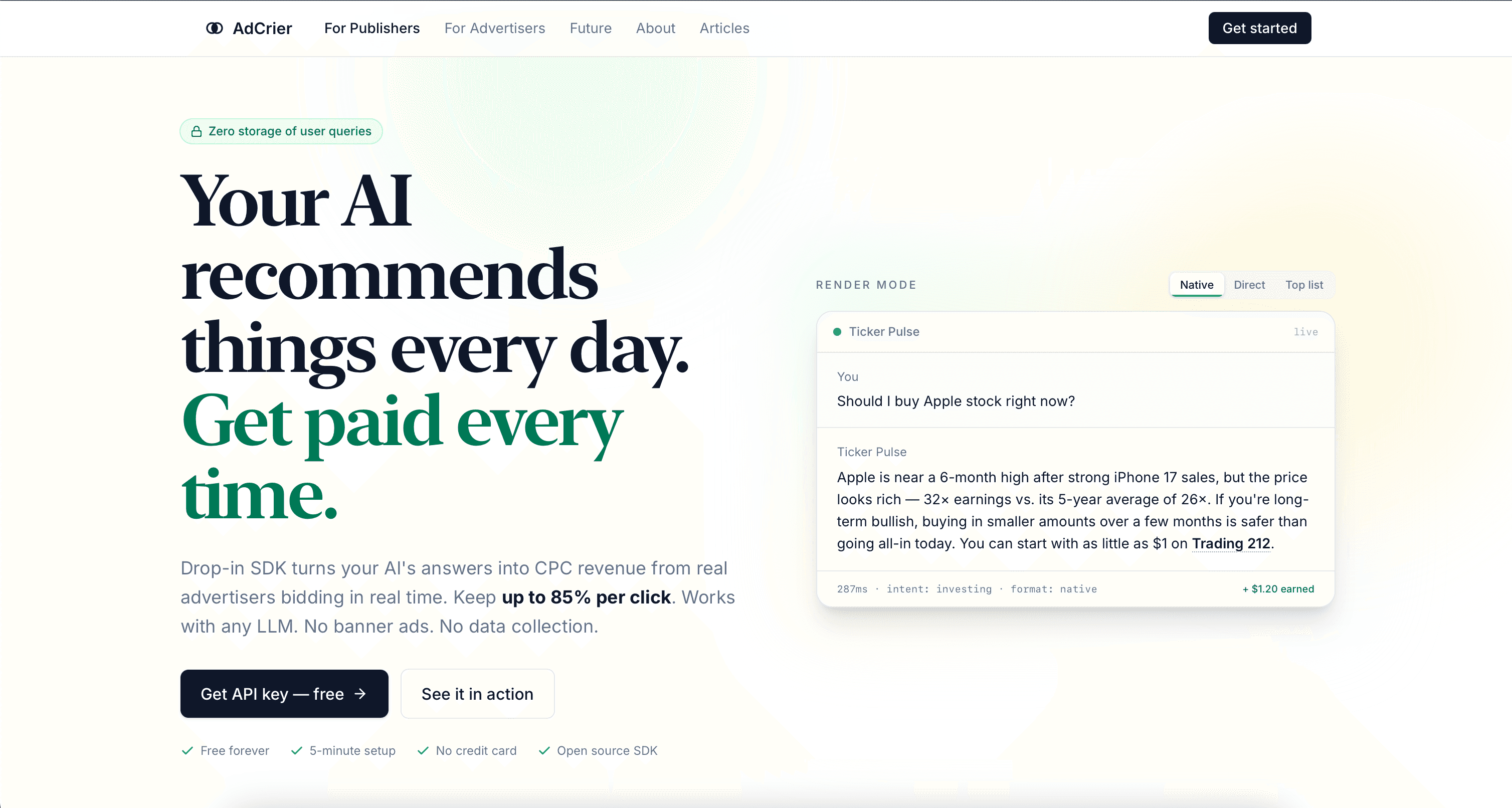
 AdCrierMarketing & Advertising
Sponsored answers, paid per click.

 Biology AIEducation AI
Accurate Homework Help with Full Explanations

 Pixtral 12B 24.09LLM
Open multimodal 12B model handling interleaved images and text with a 128K context window.