
Summon (Grade A)Security-tested data-ai skill for Claude AI. Grade A. Summon a spirit — a persistent agent that runs on a schedule or watches for conditions. Unlike `/loop` (dumb scheduler), `/summon` designs the pro

Overview
Key features
- Adaptive questioning for agent specification
- Reviewable specification generation
- Scheduled and condition-driven task support
- Local and connected mode operation
- Spirit management through .spirits/ directory
Pricing
- Model
- Free
- Category
- Skills
- Rating
- No reviews yet
Use cases
Monitoring Active Quests
Summon a spirit to periodically check on the status of active quests and report any changes or issues.
Recurring Task Automation
Use Summon to create a recurring task that runs on a schedule, such as daily or weekly, to perform specific actions or checks.
Pros & Cons
Pros
- Adaptive questioning for precise agent specification
- Reviewable spec before launching the agent
- Operates in both connected and local modes for flexibility
- Can be used for scheduled or condition-driven tasks
Cons
- Complexity in understanding and specifying agent behavior
- Dependence on Claude AI and specific configuration
- Limited direct control over low-level agent operations
Reviews
Sign in to leave a review.
No reviews yet. Be the first!
Q&A
What limitations should I be aware of when using Summon?
Summon requires a Claude AI environment and proper configuration; specifying complex agent behavior can be challenging, and low‑level control over the agent is limited compared to manual graph edits.
Asked by Hosanna Marte · Oct 30, 2025
What are the main steps in creating a spirit with Summon?
Summon first asks for the spirit’s purpose, generates options based on context (quests, sessions, existing spirits), then creates a reviewable spec before launching the agent via the chosen mode.
Asked by Xavier Costa · Oct 3, 2025
Can Summon run without connecting to the graph database?
Yes. In local mode, Summon bypasses all graph operations, generating and storing the spirit spec in the .spirits/ directory and using CronCreate/CronDelete for scheduling.
Asked by Zain Malik · Sep 13, 2025
How does Summon differ from the /loop command?
Summon uses adaptive questioning to build a reviewable specification for a persistent agent, while /loop is a simple scheduler that requires the user to know the exact task in advance.
Asked by Cristina Moreno · Jul 8, 2025
Ask a question
Skills alternatives

 Manage Headers (Grade A)Skills
Security-tested development skill for Claude AI. Grade A. Inspects and configures the security headers a Power Pages site sends to browsers — Content Security Policy, frame and clickjacking protection

 Using Git Worktrees (Grade A)Skills
Security-tested data-ai skill for Claude AI. Grade A. Use when starting feature work that needs isolation from current workspace or before executing implementation plans - creates isolated git worktre

 Ga4 Bigquery Schema (Grade A)Skills
Security-tested data-ai skill for Claude AI. Grade A. GA4 BigQuery Export Schema Reference — complete field reference, nested structures, query patterns, and performance tips

 Meta Capi (Grade A)Skills
Security-tested data-ai skill for Claude AI. Grade A. Meta Conversions API (CAPI) Setup Reference — architecture, event types, customer information hashing, deduplication, implementation examples, AEM

 Callees (Grade A)Skills
Security-tested development skill for Claude AI. Grade A. Lista o que uma funcao/metodo chama (call graph direto)

 Test Module Name (Grade A)Skills
Security-tested data-ai skill for Claude AI. Grade A. Name Haskell test modules after the module under test with a Spec suffix in the same namespace. Use when writing or reviewing Haskell test module

 Board Of Directors (Grade A)Skills
Security-tested data-ai skill for Claude AI. Grade A. Simulate a 5-member expert board deliberation for major decisions. Use when evaluating plans, architecture choices, feature designs, or any decisi

 Advpl Mvc Avancado (Grade A)Skills
Security-tested development skill for Claude AI. Grade A. MVC avançado via PE (Pontos de Entrada) — adicionar grids customizadas em telas MVC padrão (CNTA300/MATA070/MATA440/MATA460/FINA040 via *STRU)
Trending now

 Biology AIEducation AI
Accurate Homework Help with Full Explanations

 Reducto AIAI Agent Development Platforms
Document intelligence API that parses, splits, OCRs, and extracts structured data from complex PDFs, slides, and spreadsheets.
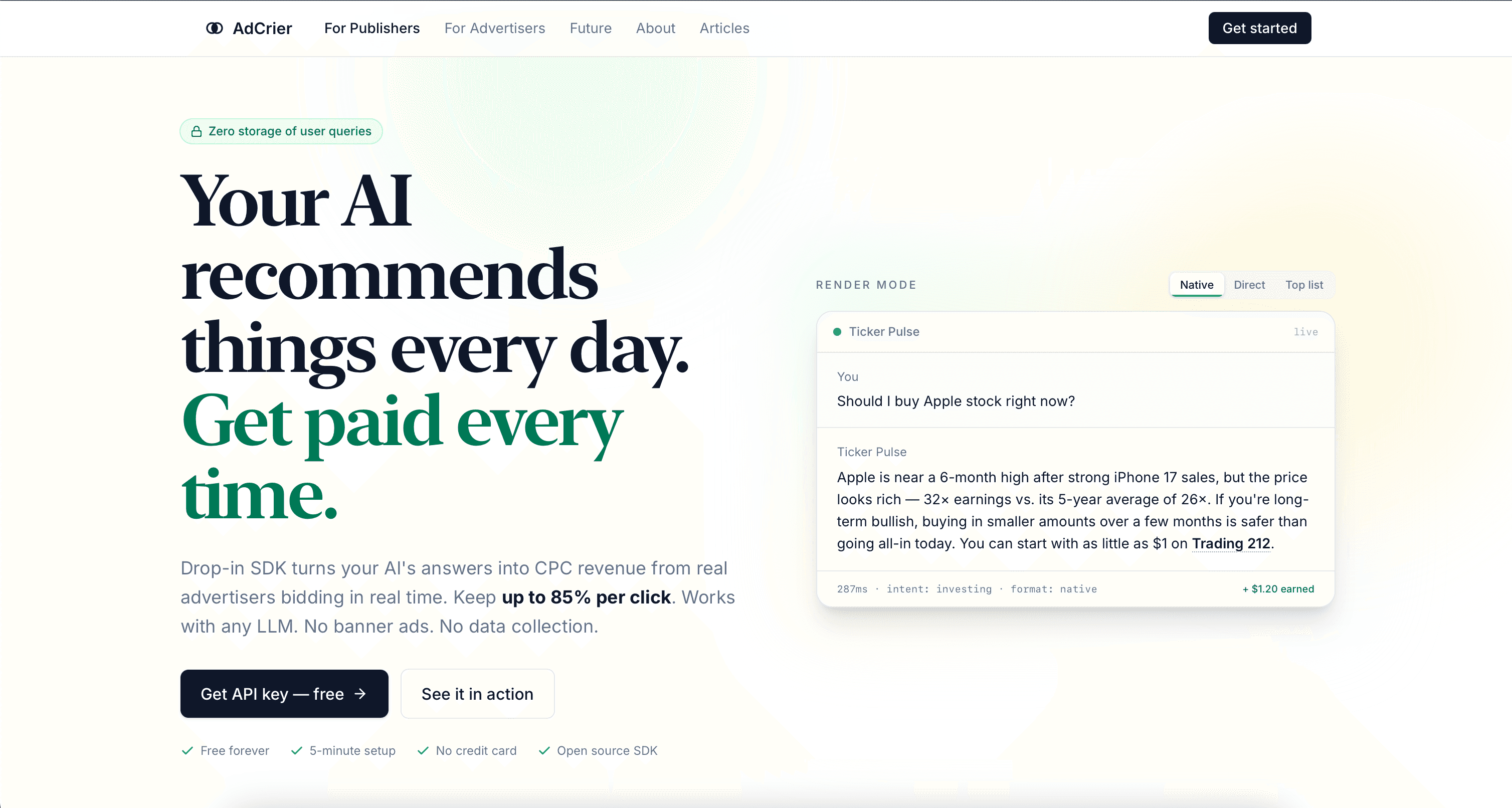
 AdCrierMarketing & Advertising
Sponsored answers, paid per click.

 Pixtral 12B 24.09LLM
Open multimodal 12B model handling interleaved images and text with a 128K context window.