
Lockedin Render Ideas (Grade A)Security-tested data-ai skill for Claude AI. Grade A. Proposes 3 to 5 next-project or career-move ideas grounded in the user's experience. One-paragraph pitch each, with cited entities. Two-turn write

Overview
Key features
- Proposes 3 to 5 ideas
- One-paragraph pitches with cited entities
- Two-turn writer/reviewer with a 5-dimension rubric
- Research-based calibration
Pricing
- Model
- Free
- Category
- Skills
- Rating
- No reviews yet
Use cases
Career Move Suggestions
A user asks for career-move pitches grounded in their actual experience, and Lockedin Render Ideas provides 3 to 5 one-paragraph pitches with cited entities.
Next Project Ideas
A user asks for suggestions on their next project, and Lockedin Render Ideas proposes 3 to 5 novel combinations of their existing skills and domains.
Pros & Cons
Pros
- Provides novel combinations of existing skills and domains
- Grounded in user's actual experience
- Cites relevant entities for each idea
Cons
- Limited to specific prompts, such as 'what should I work on next' or 'side project ideas'
- Requires a sparse vault to be seeded first via /lockedin init or ingestion
Reviews
Sign in to leave a review.
No reviews yet. Be the first!
Q&A
How it works?
1. Your experience gets structured. Drop a resume, answer a few short interview questions, or capture a moment from your current work. LockedIn organizes it into 15 typed markdown files in ~/Documents/LockedIn/. 2. Every claim is bound to a real entity. The writer turn cites companies, projects, and metrics as [[type/slug]] references pointing at specific vault files. Slugs are swapped for natural language right before you see the output. If no matching entity backs a claim, the slug stays in place and LockedIn asks you whether to add the entity rather than fabricating one. 3. Two Claudes grade. Once the writer turn finishes, a separate reviewer turn reads RUBRIC.md fresh from disk and scores. Each artifact has its own 5 dimensions (for the English resume: metric density, action verb quality, structure, banned phrases, persona fit). You get a JSON alongside the markdown with per-dimension scores 0–5, a total, cited-entity recall, and any banned-phrase hits. If any dimension lands below 4, LockedIn auto-refines once before you see the result. 4. Your experience and your conversation stay in sync. If you edited a markdown file by hand, or said something in chat that conflicts with what's already there, LockedIn notices first and asks one focused question to reconcile. This is possible because your experience is stored as typed entities, not free-form text.
Asked by Zeynep Aydin · Sep 12, 2025
Why it exists?
Most tools for organizing experience want you to leave your work, log in somewhere else, and remember everything that mattered. By then, half of it is already gone from your head. Other tools sit outside your work. LockedIn sits inside it. The moment you merge a line of code, lock in a meeting decision, or settle on a new design choice gets saved as structured experience. The flow doesn't break. Once saved, your experience connects to your outputs. Six months later when you need a resume, the six months of real work is right there, stacked as markdown in your filesystem, not in someone else's database. Carry it to any tool, reuse it for any artifact.
Asked by Jana Krejčí · Jul 25, 2025
How you use it?
No commands to memorize, no extra tab to open. Just start naturally inside Claude Code. To start fresh, build your experience from zero: "start organizing my experience", "interview me about my work history", "absorb my resume.pdf". While you're working, capture moments as they happen: "save this commit as a project highlight", "this meeting just wrapped, log it", "I just learned how to use X, track it". When you need to produce something: "make me an English resume", "I'm applying to company X for role Y, write the answer to question Z", "audit this resume PDF". LockedIn asks one question at a time when it needs more from you, and it stops when it has enough.
Asked by Winifred Adeyemi · Jul 3, 2025
Ask a question
Skills alternatives

 Using Git Worktrees (Grade A)Skills
Security-tested data-ai skill for Claude AI. Grade A. Use when starting feature work that needs isolation from current workspace or before executing implementation plans - creates isolated git worktre

 Ga4 Bigquery Schema (Grade A)Skills
Security-tested data-ai skill for Claude AI. Grade A. GA4 BigQuery Export Schema Reference — complete field reference, nested structures, query patterns, and performance tips

 Meta Capi (Grade A)Skills
Security-tested data-ai skill for Claude AI. Grade A. Meta Conversions API (CAPI) Setup Reference — architecture, event types, customer information hashing, deduplication, implementation examples, AEM

 Callees (Grade A)Skills
Security-tested development skill for Claude AI. Grade A. Lista o que uma funcao/metodo chama (call graph direto)

 Test Module Name (Grade A)Skills
Security-tested data-ai skill for Claude AI. Grade A. Name Haskell test modules after the module under test with a Spec suffix in the same namespace. Use when writing or reviewing Haskell test module

 Board Of Directors (Grade A)Skills
Security-tested data-ai skill for Claude AI. Grade A. Simulate a 5-member expert board deliberation for major decisions. Use when evaluating plans, architecture choices, feature designs, or any decisi

 Advpl Mvc Avancado (Grade A)Skills
Security-tested development skill for Claude AI. Grade A. MVC avançado via PE (Pontos de Entrada) — adicionar grids customizadas em telas MVC padrão (CNTA300/MATA070/MATA440/MATA460/FINA040 via *STRU)
Security-tested devops skill for Claude AI. Grade A. **WORKFLOW SKILL** — Maintains repository documentation accuracy and freshness across the docs site, agent files, and changelog. WHEN: "update docs
Trending now

 Biology AIEducation AI
Accurate Homework Help with Full Explanations

 Reducto AIAI Agent Development Platforms
Document intelligence API that parses, splits, OCRs, and extracts structured data from complex PDFs, slides, and spreadsheets.

 Pixtral 12B 24.09LLM
Open multimodal 12B model handling interleaved images and text with a 128K context window.
 AdCrierMarketing & Advertising
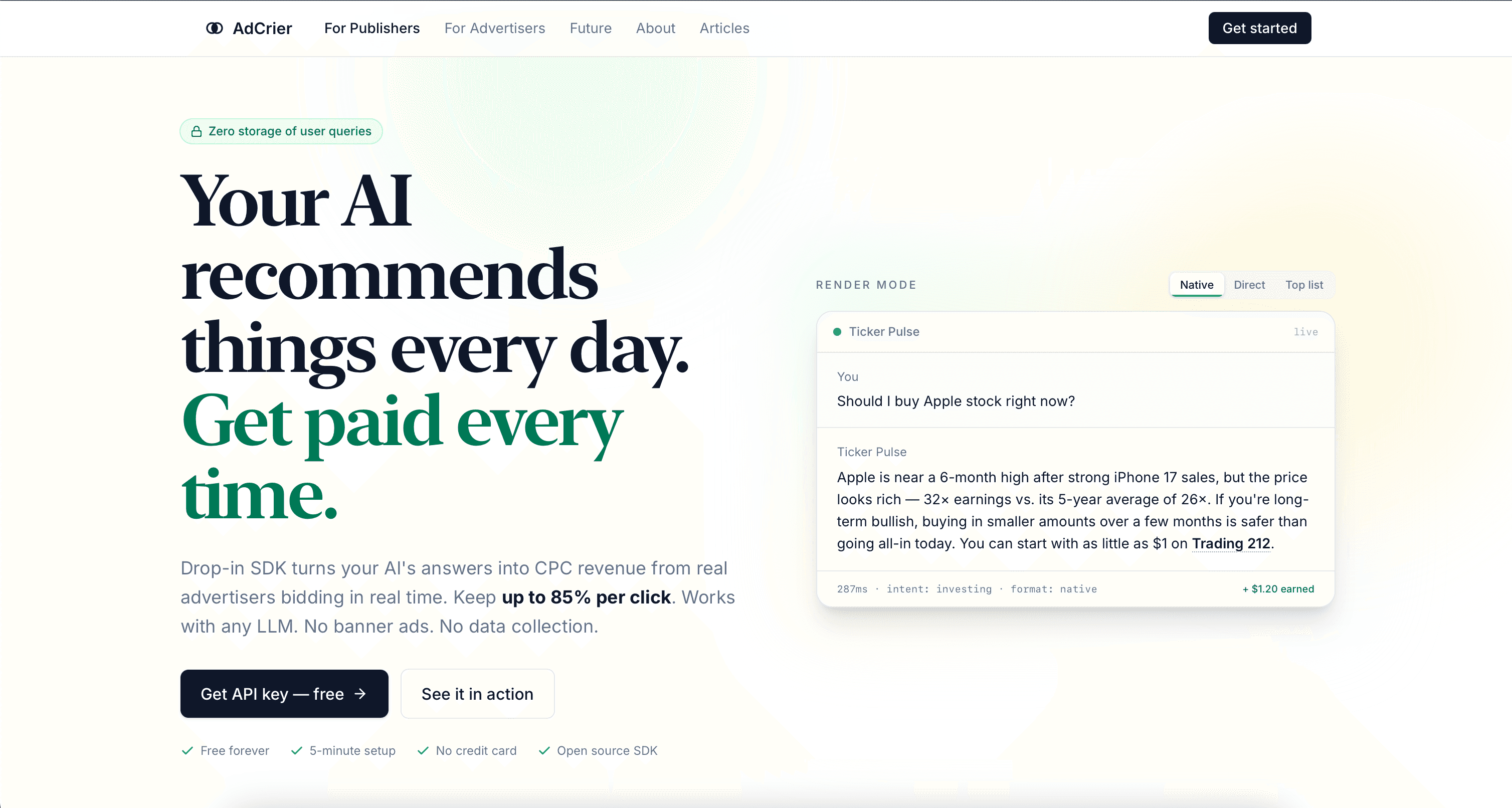
Sponsored answers, paid per click.