
Investigate (Grade A)Security-tested tools skill for Claude AI. Grade A. Systematic debugging skill. Use when encountering a bug, test failure, unexpected behavior, or when asked to "investigate", "debug", "diagnose", or

Overview
Key features
- Structured hypothesis tracking
- Five-phase workflow (Collect, Hypothesize, Verify, Fix, Verify and Report)
- Emphasis on root-cause-first discipline
- Guidance on gathering evidence and testing hypotheses
Pricing
- Model
- Free
- Category
- Skills
- Rating
- No reviews yet
Use cases
Debugging complex code issues
Investigate can be used to systematically debug complex issues in codebases, ensuring that the root cause is identified and addressed.
Investigating test failures
The skill helps users investigate test failures, gather evidence, and form hypotheses to identify and fix the root cause.
Pros & Cons
Pros
- Enforces systematic approach to debugging
- Helps avoid guess-and-fix methods
- Ensures root cause is identified before fixing
- Provides structured workflow for complex issues
Cons
- Can be time-consuming
- May require careful reading of code and logs
- Three-strike rule can lead to re-collection of data if initial hypotheses are incorrect
Reviews
Sign in to leave a review.
No reviews yet. Be the first!
Q&A
Are there any limitations to using Investigate?
Yes, Investigate can be time-consuming and may require careful reading of code and logs, with a potential need to re-collect data if initial hypotheses are incorrect.
Asked by Dmitri Volkov · Nov 27, 2025
What are the pros of using Investigate?
Investigate enforces a systematic approach, helps avoid guess-and-fix methods, and ensures the root cause is identified before fixing, providing a structured workflow for complex issues.
Asked by Jasper Vermeer · Nov 3, 2025
What workflow does Investigate follow?
Investigate involves a five-phase workflow: Collect, Hypothesize, Verify, Fix, and Verify and Report, ensuring a structured approach to debugging.
Asked by Ethan Brooks · Oct 31, 2025
What is Investigate used for?
Investigate is used for debugging, diagnosing, and figuring out why issues occur in codebases, following a systematic, root-cause-first approach.
Asked by Isabela Almeida · Oct 23, 2025
Ask a question
Skills alternatives

 Using Git Worktrees (Grade A)Skills
Security-tested data-ai skill for Claude AI. Grade A. Use when starting feature work that needs isolation from current workspace or before executing implementation plans - creates isolated git worktre

 Ga4 Bigquery Schema (Grade A)Skills
Security-tested data-ai skill for Claude AI. Grade A. GA4 BigQuery Export Schema Reference — complete field reference, nested structures, query patterns, and performance tips

 Meta Capi (Grade A)Skills
Security-tested data-ai skill for Claude AI. Grade A. Meta Conversions API (CAPI) Setup Reference — architecture, event types, customer information hashing, deduplication, implementation examples, AEM

 Callees (Grade A)Skills
Security-tested development skill for Claude AI. Grade A. Lista o que uma funcao/metodo chama (call graph direto)

 Test Module Name (Grade A)Skills
Security-tested data-ai skill for Claude AI. Grade A. Name Haskell test modules after the module under test with a Spec suffix in the same namespace. Use when writing or reviewing Haskell test module

 Board Of Directors (Grade A)Skills
Security-tested data-ai skill for Claude AI. Grade A. Simulate a 5-member expert board deliberation for major decisions. Use when evaluating plans, architecture choices, feature designs, or any decisi

 Advpl Mvc Avancado (Grade A)Skills
Security-tested development skill for Claude AI. Grade A. MVC avançado via PE (Pontos de Entrada) — adicionar grids customizadas em telas MVC padrão (CNTA300/MATA070/MATA440/MATA460/FINA040 via *STRU)
Security-tested devops skill for Claude AI. Grade A. **WORKFLOW SKILL** — Maintains repository documentation accuracy and freshness across the docs site, agent files, and changelog. WHEN: "update docs
Trending now

 Biology AIEducation AI
Accurate Homework Help with Full Explanations

 Reducto AIAI Agent Development Platforms
Document intelligence API that parses, splits, OCRs, and extracts structured data from complex PDFs, slides, and spreadsheets.

 Pixtral 12B 24.09LLM
Open multimodal 12B model handling interleaved images and text with a 128K context window.
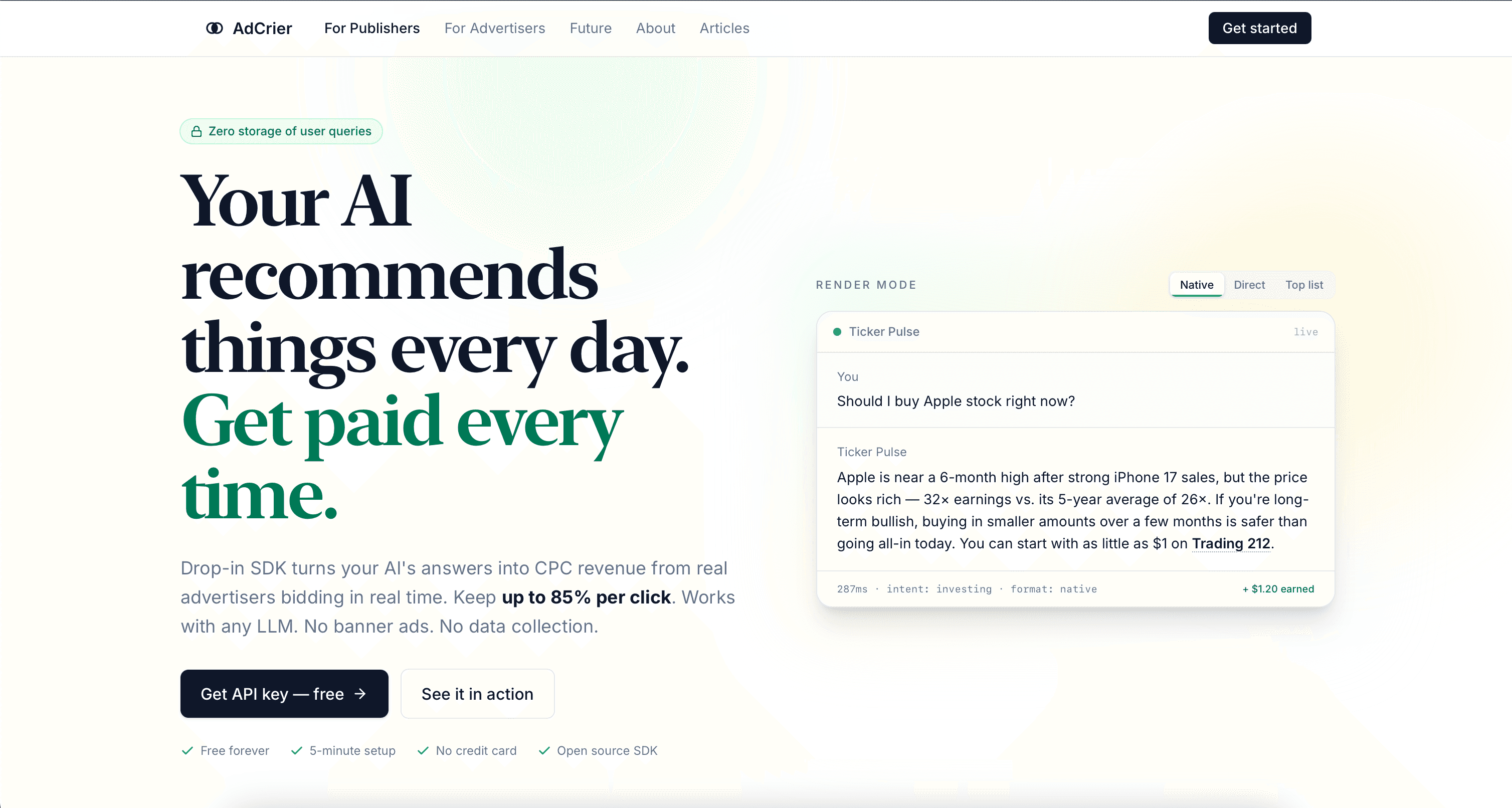
 AdCrierMarketing & Advertising
Sponsored answers, paid per click.