
Commit Message Generator (Grade A)Security-tested development skill for Claude AI. Grade A. Generate structured Conventional Commit messages from staged changes, diffs, or descriptions. Use when the user asks to write a commit message

Overview
Key features
- Generates Conventional Commit messages
- Analyzes code changes and diffs
- Classifies change types (feat, fix, docs, style, refactor, test, chore, perf, ci)
- Determines scope and writes subject line and body
- Adds footer with breaking changes, issue references, or co-authors
Pricing
- Model
- Free
- Category
- Skills
- Rating
- No reviews yet
Use cases
Feature development
Generate structured Conventional Commit messages when implementing new features or capabilities.
Bug fixing
Produce well-formatted commit messages for bug fixes and other changes, including references to resolved issues.
Code maintenance
Use the commit message generator to write commit messages for refactorings, documentation updates, and performance improvements.
Pros & Cons
Pros
- Ensures commit messages follow Conventional Commits format
- Saves time by automating commit message generation
- Improves commit message quality and consistency
- Reduces errors and inconsistencies in commit messages
Cons
- May not handle very complex or nuanced changes
- Requires a Git repository and staged changes to work effectively
- May not always perfectly capture the intent or scope of changes
Battle record
Across 1 battle in the Pantheon.
Last battle
Reviews
Sign in to leave a review.
No reviews yet. Be the first!
Q&A
What You Can Customize?
You can customize project identity (name, description, repo URL), tech stack (languages, frameworks, tools), directory paths, business domain entities, code patterns, testing quality gates, database conventions, internal package scopes, and Git/workflow conventions such as branch prefixes and commit formats.
Asked by Petros Georgiou · Oct 11, 2025
Why You Should Use This?
Individuals save over 30% token usage, avoid repeating standards, gain security guardrails, and get instant scaffolding. Teams benefit from consistent AI behavior, rapid onboarding, codified patterns, and compounded cost savings. Organizations get always-on compliance, uniform standards across many projects, central governance, and measurable ROI.
Asked by Salome Beridze · Oct 12, 2025
What it detects?
It detects language files like tsconfig.json, go.mod, Cargo.toml, requirements.txt, pom.xml, and file extensions. It also identifies frameworks from dependencies in package.json or requirements.txt (e.g., React, Express, Django, Spring), database configurations (ORM configs, .sql files, migration folders), testing setups (jest, vitest, pytest, cypress, playwright), infrastructure files (Dockerfile, terraform, cdk.json, serverless.yml), and CI/CD pipelines (.github/workflows, .gitlab-ci.yml, Jenkinsfile).
Asked by Xavier Costa · Sep 24, 2025
What's Inside?
The tool includes multiple layers: 47 always-on rules that enforce coding standards, 62 agents for complex tasks, 50 skills that provide guided workflows, 37 commands for quick actions, 12 hooks for automation scripts, and 9 templates for scaffolding handlers, components, and tests.
Asked by Katarzyna Zielinska · Jul 29, 2025
How It Works?
Layer 1 — Pre-Processing: Hooks inject project context and block dangerous commands before your prompt reaches the AI. Layer 2 — Rules Engine: 47 always-on rules enforce token efficiency, security, architecture, code standards, database conventions, and testing thresholds. Layer 3 — Specialized Processing: The right component activates — an agent, skill, or command — based on your prompt. Layer 4 — Post-Processing: Hooks validate output, auto-format, scan for secrets, and verify coverage.
Asked by Mustafa Yilmaz · Jul 14, 2025
Ask a question
Skills alternatives

 Manage Headers (Grade A)Skills
Security-tested development skill for Claude AI. Grade A. Inspects and configures the security headers a Power Pages site sends to browsers — Content Security Policy, frame and clickjacking protection

 Using Git Worktrees (Grade A)Skills
Security-tested data-ai skill for Claude AI. Grade A. Use when starting feature work that needs isolation from current workspace or before executing implementation plans - creates isolated git worktre

 Ga4 Bigquery Schema (Grade A)Skills
Security-tested data-ai skill for Claude AI. Grade A. GA4 BigQuery Export Schema Reference — complete field reference, nested structures, query patterns, and performance tips

 Meta Capi (Grade A)Skills
Security-tested data-ai skill for Claude AI. Grade A. Meta Conversions API (CAPI) Setup Reference — architecture, event types, customer information hashing, deduplication, implementation examples, AEM

 Callees (Grade A)Skills
Security-tested development skill for Claude AI. Grade A. Lista o que uma funcao/metodo chama (call graph direto)

 Test Module Name (Grade A)Skills
Security-tested data-ai skill for Claude AI. Grade A. Name Haskell test modules after the module under test with a Spec suffix in the same namespace. Use when writing or reviewing Haskell test module

 Board Of Directors (Grade A)Skills
Security-tested data-ai skill for Claude AI. Grade A. Simulate a 5-member expert board deliberation for major decisions. Use when evaluating plans, architecture choices, feature designs, or any decisi

 Advpl Mvc Avancado (Grade A)Skills
Security-tested development skill for Claude AI. Grade A. MVC avançado via PE (Pontos de Entrada) — adicionar grids customizadas em telas MVC padrão (CNTA300/MATA070/MATA440/MATA460/FINA040 via *STRU)
Trending now

 Reducto AIAI Agent Development Platforms
Document intelligence API that parses, splits, OCRs, and extracts structured data from complex PDFs, slides, and spreadsheets.
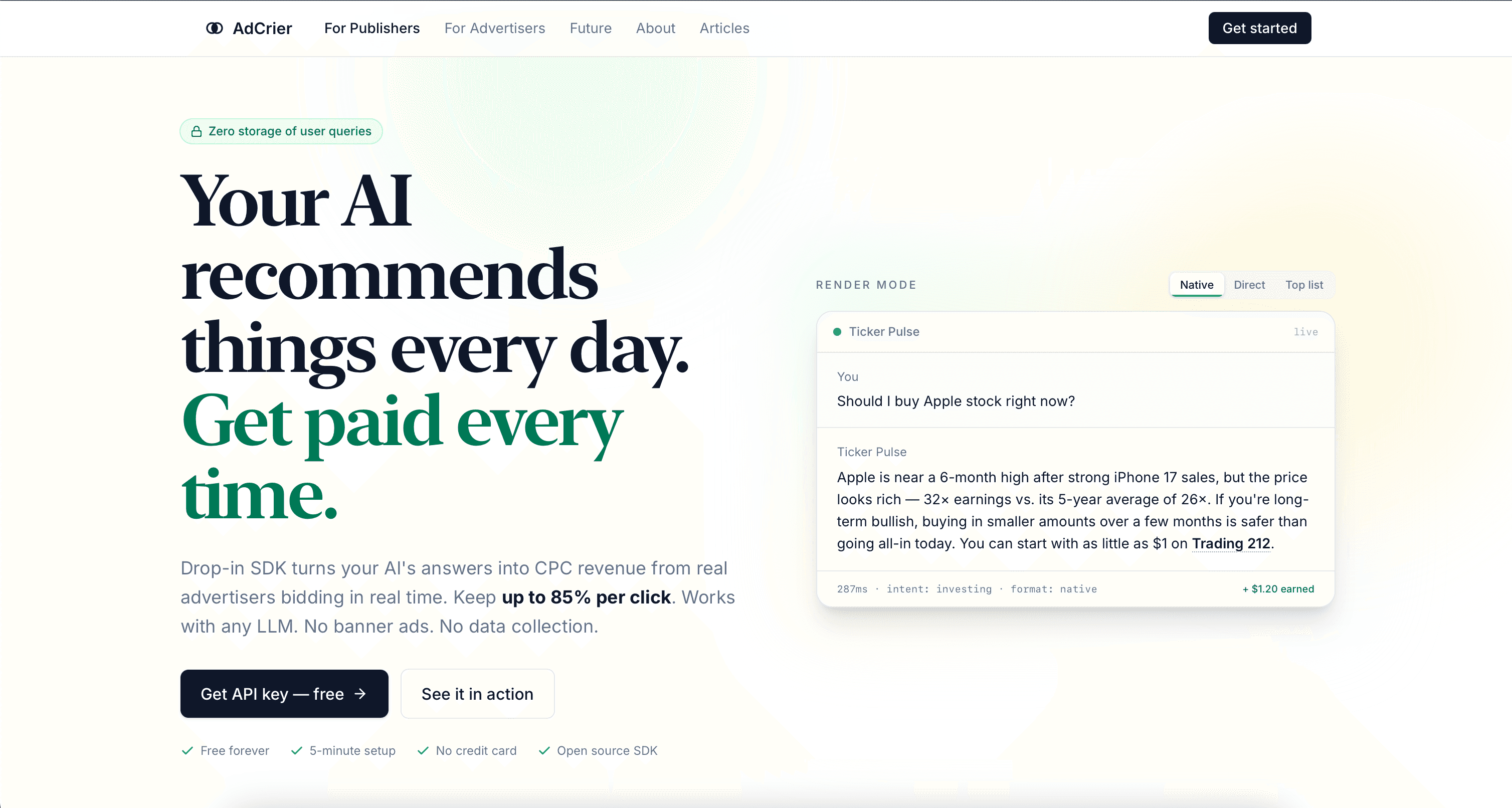
 AdCrierMarketing & Advertising
Sponsored answers, paid per click.

 Biology AIEducation AI
Accurate Homework Help with Full Explanations

 Pixtral 12B 24.09LLM
Open multimodal 12B model handling interleaved images and text with a 128K context window.