
Cloud Iam Deep (Grade A)Saugumo išvertinama saugumo išvertinimo sritis gavusiam Claude AI. A pagrindas. Apėjimas pagal AWS, Azure, GCP ir užėjo priimčių kėsimo pažaudinus prieiga informaciją galimybės

Apžvalga
Pagrindinės funkcijos
- AWS, Azure ir GCP prieiga informaciją išlaikymo enumeracija
- STS / AssumeRole grandinėlė ir Azure valdomasis Identifikavimas pernugnumtas
- GCP paslaugų vartotojo JSON pernugnumtas ir IMDSv1/v2 išpuolio
- K8s paslaugų vartotojo ženklas privilegijų analizė ir rolės-draugystės politika sužadėtųjų žmogus
- Paslaugos vartotojo ženklai užėjo priimčių enumeracija ir IAM privilegijų pakėsimų tipai
- AWS Cognito Identity Pool neprikrovimo prie pagrindinės srities pakeliui
Kainos
- Modelis
- Free
- Kategorija
- Garsai
- Įvertinimas
- Atsiliepimų nėra
Naudojimo atvejai
Nuorodos atsira cloud priežasčių apie
Naudojama kai nuodėtis nuorodos apie nuoroda atsiras, pvz., klavišo, paslapties, ženklas arba JSON failas ir reikia nustatyti, kas jis suteikia ir kaip pakėsitį privilegijas.
Pakeliuoju po šalinės programavimo vykdomoji (RCE) puolio
Naudojama po šalinės programavimo vykdomojo (RCE) puolio, vykdomoja aplinkoje esančio instanco pereinamąjį prie cloud kontrolinis planšetas.
Privalumai ir trūkumai
Privalumai
- Įvairių cloud platformų saugumo administravimo ir privilegijų pakėsimų apžvalginė galeja
- Uždėti užėjo priimčių kėsimų pakelius ir prieiga informaciją analizė po išlaikymo atgal po
- Įtrauktas įrankių bei technikų užkrovimas nustatytis ir panaudoti cloud priežasčių
Trūkumai
- Suderinama tik užėjo priimčių kėsimų pakeliui ir gali nepriežiūriu tikriejių užėjo priimčių
- Reikalauja egzistuojančių cloud saugumo ir saugumo administravimo priemonių žinių
- Jis gali nebūt tinkamas pagrindinių apleisų aplinkų nusistovėjimuose arba netiesioginių cloud saugumo išpūlio įvykiai
Atsiliepimai
Prisijunk, kad paliktum atsiliepimą.
Atsiliepimų nėra. Būk pirmas!
Klausimai
Why this exists?
Most bug‑hunting Claude setups are either too generic (one big "security" prompt) or too fragmented (you bookmark 30 disclosed reports and re‑read them every engagement). Neither scales past the second target. This bundle was built and validated through authorized engagements that exposed different capability gaps: Bug‑bounty engagement — surfaced four gaps a starter 3‑skill stack could not close: 1. No hypothesis discipline — drafts written before validation → wasted hours, hurt validity ratio 2. No per‑program reporting tactics — VRT defaults auto‑downgraded P3‑worthy findings to P4 3. No engagement coordination — findings, evidence, and submission IDs scattered across folders 4. No evidence hygiene — screenshots leaked cookies and victim PII External red‑team engagement — exposed five additional gaps that bug‑bounty defaults made worse: 1. Conservative defaults retracted real findings — WAPT mindset stopped tests early on defended targets where red‑team continuation would have surfaced bypass chains → redteam‑mindset 2. No mid‑engagement situational awareness — client SOC patched confirmed SQLi within 30 min; external attacker locked 14 accounts during a live test session — both invisible without explicit detection methodology → mid‑engagement‑ir‑detection 3. No enterprise‑platform attack chains — M365 + Entra ID, on‑prem SharePoint, Cisco SSL VPN, vCenter, and 7 Android APKs all needed current 2024‑2026 CVE knowledge and platform‑specific tradecraft → m365‑entra‑attack, .
Asked by Zelda Brandt · Sep 4, 2025
Why your model switched mid‑session?
Separate from refusals, and easy to miss. On Opus 5, a narrow set of higher‑risk cyber requests — Anthropic names exploit generation, binary‑based vulnerability scanning and penetration testing — fall back to Opus 4.8 rather than being refused. You get a notice and the response is labelled with the model that answered, but in a long agentic run that is easy to scroll past, so it can look like Opus 5 quietly got worse. See why Claude switched models. What to do depends on what you are actually doing: | Situation | What helps | |---|---| | Auditing your own code — reviewing a repo you own for defects | Say so. "Defensive review of my own repo", "check this against the OWASP Top 10", "secure refactor to remediate" describe the work accurately and read as remediation. | | Authorized offensive work — live engagement, PoC for a bounty submission | This is what the bundle is for, and the supported route is CVP. Do not reword an offensive engagement to look defensive to get past a classifier — enroll instead. | | You just want the switching off | Settings → Capabilities disables automatic model switching. | /hunt states the engagement frame (authorized, scope‑bounded, remediable finding) on its first turn for exactly this reason — engagement context belongs in the session explicitly, not implied.
Asked by Anders Lindgren · Aug 28, 2025
How it works?
A 6‑phase, non‑linear workflow — recon → map & rank → hunt → validate → report — with scope enforced in code and a 7‑Question Gate before anything is submitted. Two ways to drive it: Plain English — describe what you're testing and the relevant skill loads automatically. /hunt scaffold + cbh CLI — engagement‑folder structure, state, and orchestration. Includes a usage guide, worked example, 6‑phase architecture diagram, and the cbh CLI.
Asked by Frank Müller · Aug 16, 2025
What's inside?
82 skills, auto‑loaded by topic — no invocation by name. Coverage across the external attack surface: | Category | # | Examples | |---|---|---| | Web application hunting | 13 | XSS, SQLi, SSRF, IDOR, LFI, SSTI, XXE, CSRF, CORS, open‑redirect | | Authentication & identity | 7 | auth‑bypass, session, OAuth, SAML, MFA‑bypass, ATO | | API & infrastructure | 15 | GraphQL, gRPC, WebSocket, API‑misconfig, host‑header, RCE | | Advanced & concurrency | 6 | race‑condition, HTTP smuggling, deserialization, cache‑poison | | Framework‑specific | 4 | Next.js, Node.js, Laravel, Spring Boot | | Enterprise identity & cloud ★ | 3 | M365/Entra, Okta, cloud‑IAM‑deep | | Infrastructure & appliance ★ | 4 | VMware vCenter, enterprise VPN, SharePoint, ASP.NET/NTLM | | Red‑team tradecraft ★ | 4 | redteam‑mindset, APK pipeline, supply‑chain recon, mid‑engagement IR | | Recon & OSINT | 4 | web2‑recon, offensive‑osint, subdomain | | Workflow, reporting & specialized | 11 | methodology, triage‑validation, evidence‑hygiene, VRT‑aware reporting | Full searchable catalog → docs/skills.md. Also ships 15 slash commands (/hunt, /recon, /report, …) and a deterministic engagement engine (engine/) that maps a target's attack surface and routes each finding to the skill that handles it.
Asked by Carmela Esposito · Aug 12, 2025
What is this?
claude-bughunter is a drop-in skill bundle for the Claude Code skills system. Install once and Claude Code stops being a chatbot and starts behaving like a senior bug‑hunting researcher or red‑team operator: it knows the techniques, the chain templates, the VRT mappings, the platform CVE chains, and the hygiene — and it stays in scope. Four layers stack: Think — bb‑methodology + redteam‑mindset: the 5‑phase non‑linear workflow, critical‑thinking framework, and red‑team operator discipline. Hunt webapps — 48 hunt‑skills curated from 681 disclosed HackerOne reports: per‑class detection patterns, payloads, bypass tables, and chain templates. Hit the perimeter — enterprise platform chains (M365/Entra, Okta, vCenter, SSL‑VPN appliances, SharePoint, cloud IAM): current 2024–2026 CVE chains + post‑credential escalation. Ship it — triage‑validation + reporting + evidence‑hygiene: the 7‑Question Gate, VRT‑aware severity, OOS rebuttals, PII redaction, and red‑team deliverables. All triggered automatically by topic — describe what you're testing in plain English and the relevant skill loads. No invocation by name.
Asked by George Papadakis · Aug 10, 2025
Užduoti klausimą
Garsai alternatyvos

 Using Git Worktrees (Grade A)Garsai
Sąskaitomi bei apmokyti duomenų-ai skaičiavimo įgūnis Claude-ai. A. G. Išmokite, kai pradedate kūrybą, kuriai reikia išsiskyrimo nuo esamo darbų kūrybos arba perkeliaite išgyvendinimo planus – sukuria atsargų Git darbų šakas

 Ga4 Bigquery Schema (Grade A)Garsai
Saugumu patikrinta duomenų - ai technine sritis, skirta Claude AI. Švyturys A. GA4 BigQuery Eksporto Schema Referencija - kompleksus laukų rodiklio sąrašas, rėmės strūkture, klausimų modeliai ir patikimumo nuorodos

 Meta Capi (Grade A)Garsai
Saugumai patikrintas duomenų-ai sąrašo paslankiems Claude AI. Rangos A. Meta apskaitos API (CAPI) Konfigūracijos Rodelė — architektūra, renginių tipai, konsultacinių duomenų šachojimas, priešpriešųjų apskaičiavimas, įgyvendinimo pavyzdžiai, AEM

 Callees (Grade A)Garsai
Saugos patikrintas vystymo sąmįstis Claude AI. Laipsnis A. Sąrašas, kas viena funkcija/metodas vadinama (prieiga tiesioginis grafikas)

 Test Module Name (Grade A)Garsai
Šio tyrimo užtikrintas duomenų-ai sistema Claude AI. B laipsniu. Pavadinkite Haskelio testinę modulį pagal testuojamą modulį Spec pavadinimų pavidalu tam pačioje namespaceje.

 Board Of Directors (Grade A)Garsai
Raidą testuotas duomenų-ai mokslinių galimybių kompetencija Claude AI. A. Simuliuoti 5 narių specialistų reikalingų sprendimų komiteto diskusiją. Naudoti kad įvertintų planus, architektūros pasirinkimus, prietaiso dizainus, ar bet ką kitą sprendimą, kuris reikalauja daugiakampio specialistų analizės.

 Advpl Mvc Avancado (Grade A)Garsai
Sekuringas tobulas sistema reikšmė su Claude AI. A klasė. MVC avansas per PE (Priedangų Taškų) – priedangų nuoseklumo gridų papildymas į standardinius MVC ekranus (CNTA300/MATA070/MATA440/MATA460/FINA040 per *STRU)
Visuotinai patikrinti devops kompetencijos klaida, skirta Claude AI, Grade A. **KELIAKOJI KLĀDA** — Įsaugo dokumentu pildyklės taiklį ir naujienų širdį visuose svetainėse, agentų failuose ir keitų sąrašuose.
Trending now

 Biology AIMokymosi AI
Savitai Homelaida Pomoja su Pilnomisės Paaiškinimais

 Reducto AIIntelektualiosioms Agentųsių Plataformos sukurimo
Documentų inteligentijos API, kuris skaidrysta, skaido, OCR-a ir ištrina išsiaugstiną duomenų medžiagą iš kompleksinių PDF, presentacijų ir lentelių, kuris išsaugo sprendimus ir grafikai iš lentelių ir grafo duomenų.

 Pixtral 12B 24.09MOL
Atvira multimodala 12B modelis, prieinama keliame vaizdų ir tekstų su 128K konteksto langeliu.
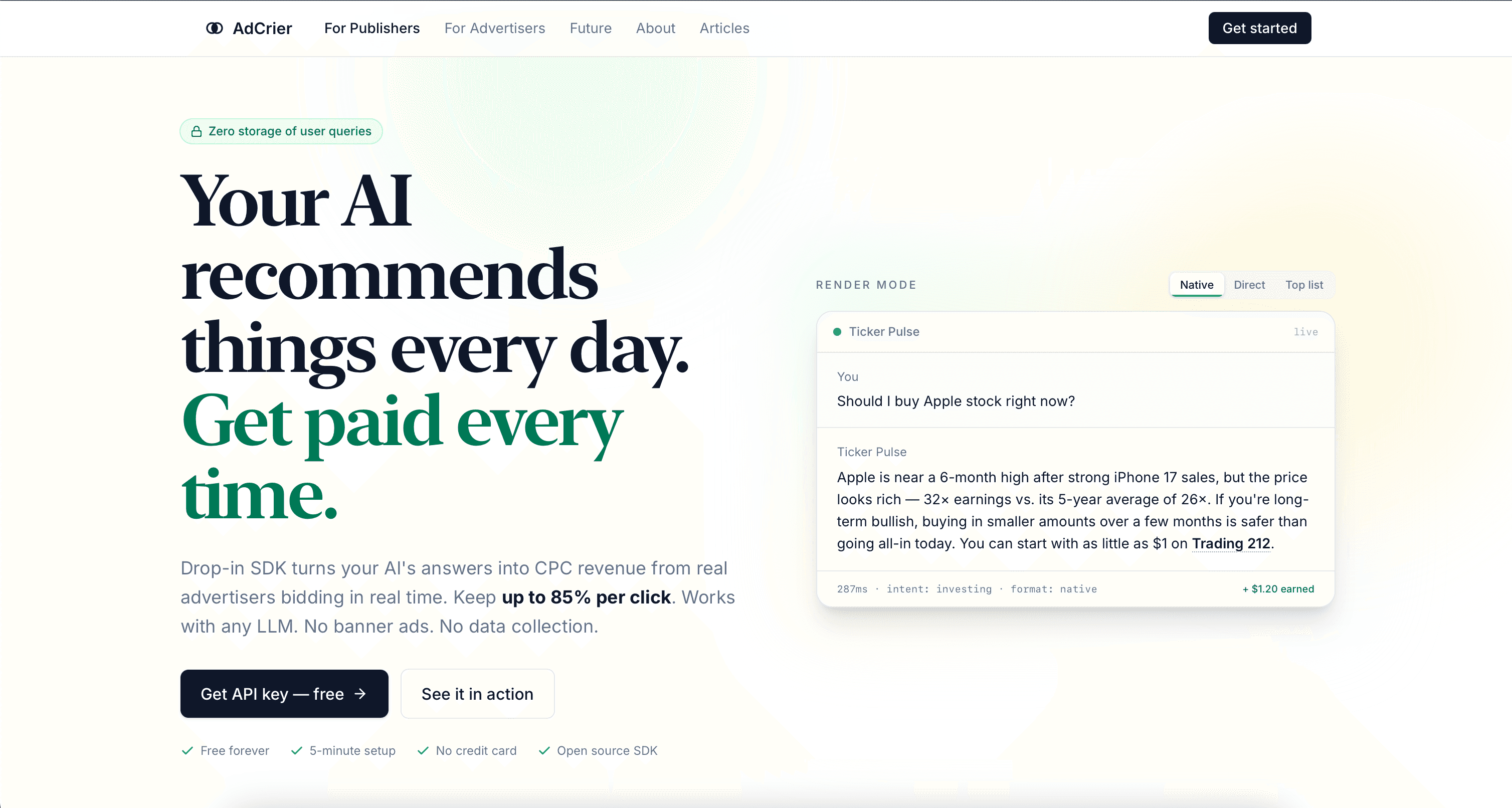
 AdCrierReklama & Rinkimai
Sponsoriai atsakymai, mokama už kliktą.