
Cloud Iam Deep (Grade A)Test di sicurezza testata con sicurezza per la competenza di Claude AI. Valutazione A. Catena di attacco rossa del team IAM nel cloud su AWS, Azure, GCP — concentrata sui percorsi di sfruttamento esterni e l'analisi delle prerogative dopo la scoperta delle credenziali.

Panoramica
Funzionalità chiave
- Enumerazione dell'IAM per AWS, Azure e GCP
- Concatenazione di STS/AssumeRole e abuso dell'identità gestita di Azure
- Abuso dei file JSON delle servizi di GCP e attacchi IMDSv1/v2
- Analisi delle prerogative del token ServiceAccount di K8s e politica di fiducia confusa del ruolo
- Enumerazione incrociata dell'assume-role e modelli di escalation delle prerogative del servizio IAM
- Catena di attacco non autenticato del pool di identità cognito di AWS
Prezzi
- Modello
- Free
- Categoria
- Competenze
- Valutazione
- Nessuna recensione
Casi d’uso
Sfida della credenziale nel cloud
Usa quando una credenziale cloud emerge, come una chiave, una parola segreta, un token o un file JSON, e puoi determinare cosa concesso ha questa credenziale e come accelerare le prerogative.
Sfida di pivot post-RCE
Usa dopo un attacco di esecuzione del codice remoto (RCE) su un istanza ospitata nel cloud per saltare alla catena di controllo cloud.
Pro & contro
Pro
- Copertura completa dell'enumerazione dell'IAM e l'escalation delle prerogative su piattaforme cloud multiple
- Focus sui percorsi di sfruttamento esterno e l'analisi delle prerogative post-credenziali
- Comprensione degli strumenti e delle tecniche per l'identificazione e l'abuso delle credenziali cloud
Contro
- Limitato ai percorsi di sfruttamento esterno e potrebbe non coprire le minacce interne
- Richiede knowledge esistente sulla sicurezza cloud e i concetti dell'IAAM
- Potrebbe non essere adatto per gli ambienti in rete locale o per le attività di test di sicurezza non legate al cloud
Recensioni
Accedi per lasciare una recensione.
Nessuna recensione. Sii il primo!
Domande e risposte
Why this exists?
Most bug‑hunting Claude setups are either too generic (one big "security" prompt) or too fragmented (you bookmark 30 disclosed reports and re‑read them every engagement). Neither scales past the second target. This bundle was built and validated through authorized engagements that exposed different capability gaps: Bug‑bounty engagement — surfaced four gaps a starter 3‑skill stack could not close: 1. No hypothesis discipline — drafts written before validation → wasted hours, hurt validity ratio 2. No per‑program reporting tactics — VRT defaults auto‑downgraded P3‑worthy findings to P4 3. No engagement coordination — findings, evidence, and submission IDs scattered across folders 4. No evidence hygiene — screenshots leaked cookies and victim PII External red‑team engagement — exposed five additional gaps that bug‑bounty defaults made worse: 1. Conservative defaults retracted real findings — WAPT mindset stopped tests early on defended targets where red‑team continuation would have surfaced bypass chains → redteam‑mindset 2. No mid‑engagement situational awareness — client SOC patched confirmed SQLi within 30 min; external attacker locked 14 accounts during a live test session — both invisible without explicit detection methodology → mid‑engagement‑ir‑detection 3. No enterprise‑platform attack chains — M365 + Entra ID, on‑prem SharePoint, Cisco SSL VPN, vCenter, and 7 Android APKs all needed current 2024‑2026 CVE knowledge and platform‑specific tradecraft → m365‑entra‑attack, .
Asked by Zelda Brandt · Sep 4, 2025
Why your model switched mid‑session?
Separate from refusals, and easy to miss. On Opus 5, a narrow set of higher‑risk cyber requests — Anthropic names exploit generation, binary‑based vulnerability scanning and penetration testing — fall back to Opus 4.8 rather than being refused. You get a notice and the response is labelled with the model that answered, but in a long agentic run that is easy to scroll past, so it can look like Opus 5 quietly got worse. See why Claude switched models. What to do depends on what you are actually doing: | Situation | What helps | |---|---| | Auditing your own code — reviewing a repo you own for defects | Say so. "Defensive review of my own repo", "check this against the OWASP Top 10", "secure refactor to remediate" describe the work accurately and read as remediation. | | Authorized offensive work — live engagement, PoC for a bounty submission | This is what the bundle is for, and the supported route is CVP. Do not reword an offensive engagement to look defensive to get past a classifier — enroll instead. | | You just want the switching off | Settings → Capabilities disables automatic model switching. | /hunt states the engagement frame (authorized, scope‑bounded, remediable finding) on its first turn for exactly this reason — engagement context belongs in the session explicitly, not implied.
Asked by Anders Lindgren · Aug 28, 2025
How it works?
A 6‑phase, non‑linear workflow — recon → map & rank → hunt → validate → report — with scope enforced in code and a 7‑Question Gate before anything is submitted. Two ways to drive it: Plain English — describe what you're testing and the relevant skill loads automatically. /hunt scaffold + cbh CLI — engagement‑folder structure, state, and orchestration. Includes a usage guide, worked example, 6‑phase architecture diagram, and the cbh CLI.
Asked by Frank Müller · Aug 16, 2025
What's inside?
82 skills, auto‑loaded by topic — no invocation by name. Coverage across the external attack surface: | Category | # | Examples | |---|---|---| | Web application hunting | 13 | XSS, SQLi, SSRF, IDOR, LFI, SSTI, XXE, CSRF, CORS, open‑redirect | | Authentication & identity | 7 | auth‑bypass, session, OAuth, SAML, MFA‑bypass, ATO | | API & infrastructure | 15 | GraphQL, gRPC, WebSocket, API‑misconfig, host‑header, RCE | | Advanced & concurrency | 6 | race‑condition, HTTP smuggling, deserialization, cache‑poison | | Framework‑specific | 4 | Next.js, Node.js, Laravel, Spring Boot | | Enterprise identity & cloud ★ | 3 | M365/Entra, Okta, cloud‑IAM‑deep | | Infrastructure & appliance ★ | 4 | VMware vCenter, enterprise VPN, SharePoint, ASP.NET/NTLM | | Red‑team tradecraft ★ | 4 | redteam‑mindset, APK pipeline, supply‑chain recon, mid‑engagement IR | | Recon & OSINT | 4 | web2‑recon, offensive‑osint, subdomain | | Workflow, reporting & specialized | 11 | methodology, triage‑validation, evidence‑hygiene, VRT‑aware reporting | Full searchable catalog → docs/skills.md. Also ships 15 slash commands (/hunt, /recon, /report, …) and a deterministic engagement engine (engine/) that maps a target's attack surface and routes each finding to the skill that handles it.
Asked by Carmela Esposito · Aug 12, 2025
What is this?
claude-bughunter is a drop-in skill bundle for the Claude Code skills system. Install once and Claude Code stops being a chatbot and starts behaving like a senior bug‑hunting researcher or red‑team operator: it knows the techniques, the chain templates, the VRT mappings, the platform CVE chains, and the hygiene — and it stays in scope. Four layers stack: Think — bb‑methodology + redteam‑mindset: the 5‑phase non‑linear workflow, critical‑thinking framework, and red‑team operator discipline. Hunt webapps — 48 hunt‑skills curated from 681 disclosed HackerOne reports: per‑class detection patterns, payloads, bypass tables, and chain templates. Hit the perimeter — enterprise platform chains (M365/Entra, Okta, vCenter, SSL‑VPN appliances, SharePoint, cloud IAM): current 2024–2026 CVE chains + post‑credential escalation. Ship it — triage‑validation + reporting + evidence‑hygiene: the 7‑Question Gate, VRT‑aware severity, OOS rebuttals, PII redaction, and red‑team deliverables. All triggered automatically by topic — describe what you're testing in plain English and the relevant skill loads. No invocation by name.
Asked by George Papadakis · Aug 10, 2025
Fai una domanda
Alternative a Competenze

Manage Headers (Grade A)
Competenze
Abilità di sviluppo testata per le sicurezza per Claude AI. Grade A. Esamina e configura le intestazioni di sicurezza che un sito Power Pages invia ai browser — politica di sicurezza del contenuto, protezione dalle frame e clickjacking

Using Git Worktrees (Grade A)
Competenze
Skill di sicurezza testata ai dati-ai per Claude AI. Classificata A. Usare quando si inizia il lavoro di feature che richiede l'isolamento dallo stato attuale del workspace o prima di eseguire i piani di implementazione - crea un repository git worktree isolato.

Ga4 Bigquery Schema (Grade A)
Competenze
Skill di dati ai testata per la sicurezza di Claude AI. Schema di esportazione di BigQuery GA4 di classe A.

Meta Capi (Grade A)
Competenze
Skill per la sicurezza dei dati-ai per Claude AI. Classe A. Riferimento di configurazione della piattaforma Meta Conversions API (CAPI)

Callees (Grade A)
Competenze
Competenza di sviluppo testata a livello di sicurezza per Claude AI. Grade A. Elenco di tutto ciò a cui una funzione o metodo invoca (call graph diretto)

Test Module Name (Grade A)
Competenze
Modulo di test sicuro per abilità AI dati da Claude AI. Grade A. Nome i moduli di test Haskell dopo il modulo da testare con suffisso Spec nel medesimo namespace. Utilizzare quando si scrivono o si vengono recensiti i moduli di test Haskell.

Board Of Directors (Grade A)
Competenze
Skill di AI dati con prova di sicurezza di alta qualità per Claude AI. Classe A. Simula una deliberazione di un collegio di esperti con 5 membri per le maggiori decisioni. Utilizzare quando si valuta i piani, le scelte di architettura, i progetti di design o qualsiasi altra decisione

Advpl Mvc Avancado (Grade A)
Competenze
Skill di sviluppo testata per la sicurezza per Claude AI. Grade A. MVC avanzato tramite PE (Pontos de Entrada) — aggiungere griglie personalizzate in schermate MVC standard (CNTA300/MATA070/MATA440/MATA460/FINA040 via *STRU)
Trending now


Reducto AI
Piattaforme per lo Sviluppo di Agenti AI
API di intelligenza dei documenti che elabora, suddivide, riconosce testi da immagine e estrae dati strutturati da PDFs complessi, diapositive e fogli elettronici
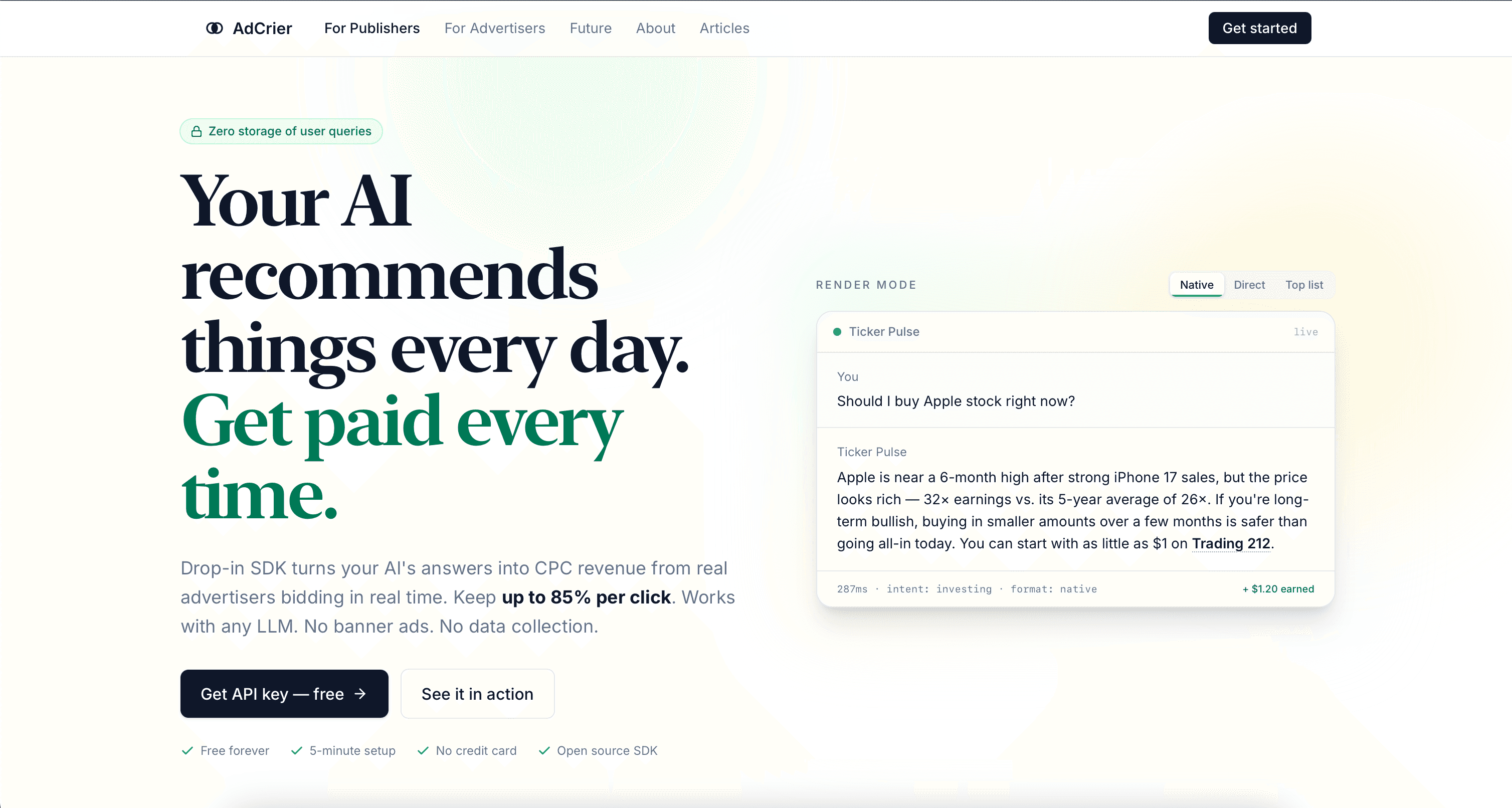

AdCrier
Marketing & Publicità
Risposte sponsorizzate, pagate per clic


Biology AI
Intelligenza Artificiale per l"Educazione
Aiuto di Alta Qualità per i Compiti con Spiegazioni Dettagliate


Pixtral 12B 24.09
Modelli Linguistici di Raffinamento
Modello multimodale di 12B con finestra di contesto di 128K per l'elaborazione di immagini e testi intercalati.