
Neon AIServerless Postgres für KI-Agenten und Entwickler, die schnell ausliefern

Übersicht
Hauptfunktionen
- Serverless Postgres mit automatischer Skalierung des Compute
- Git‑ähnliches Datenbankbranching und Restore zum Zeitpunkt des Backups
- pgvector-Erweiterung für Einbettungen und Ähnlichkeitssuche
- Trennung von Speicher und Compute
- Entwickler‑API zur programmatischen Verwaltung von Datenbanken
- Preview‑Umgebungen und CI/CD‑Integration
Preise
- Modell
- Freemium
- Kategorie
- Agent Memory
- Bewertung
- 4.5 / 5 (4)
Anwendungsfälle
Vektor‑Speicher für RAG-Anwendungen
Nutzen Sie die pgvector-Erweiterung, um Einbettungen für retrieval-augmented generation zu speichern und abzufragen, wodurch KI-Anwendungen mit Ähnlichkeitssuche auf einem vertrauten Postgres‑Backend unterstützt werden.
Agenten‑verwaltete Datenbanken
Lassen Sie KI-Agenten ihre eigenen Postgres-Datenbanken über die Entwickler‑API bereitstellen, konfigurieren und entfernen, um autonome Workflows und Datenisolierung pro Agent zu ermöglichen.
Preview‑Umgebungen in CI/CD
Erstellen Sie Git‑ähnliche Datenbankbranches für jede Pull‑Request, um Schemaänderungen und Migrationen gegen produktionsähnliche Daten zu testen, und verwerfen Sie sie anschließend nach dem Merge.
Kosten‑effiziente Entwicklungs- und Staging‑Umgebungen
Nutzen Sie die Scale‑to‑Zero‑Preisgestaltung und die Trennung von Speicher und Compute, um viele Nicht‑Produktionsdatenbanken kostengünstig laufen zu lassen, die nur bei Bedarf hochgefahren werden.
Pro & Contra
Pro
- Vollständige PostgreSQL-Kompatibilität ohne Vendor‑Lock‑in
- Datenbankbranching beschleunigt Tests und CI‑Workflows
- Scale‑to‑Zero‑Preisgestaltung senkt Leerlaufkosten
- Native pgvector-Unterstützung für KI‑ und RAG‑Anwendungen
- API‑first‑Design funktioniert gut mit KI‑Agenten
Contra
- Kaltstarts können nach Ruhezeiten Latenz erzeugen
- Fortgeschrittene Features erfordern das Erlernen von Neon‑spezifischen Konzepten
- Die Limits der kostenlosen Stufe können bei größeren Workloads eng sein
Schlacht-Bilanz
Aus 6 Schlachten im Pantheon.
Last 5 battles
- #1
Agent Memory Showdown — June 6, 2026
Jun 6, 2026 · #1 of 2
- #2
Agent Memory Showdown — June 27, 2025
Jun 27, 2025 · #2 of 2
- #1
Agent Memory Showdown — February 16, 2025
Feb 16, 2025 · #1 of 2
- #1
Agent Memory Showdown — October 17, 2024
Oct 17, 2024 · #1 of 2
- #2
Agent Memory Showdown — August 29, 2024
Aug 29, 2024 · #2 of 2
Bewertungen
Durchschnitt aus 4 Bewertungen.
Melde dich an, um eine Bewertung abzugeben.

Years in this space
I've evaluated a lot of these over the years. What stands out here is pgvector extension for embeddings and similarity search — handled better than most — and scale-to-zero pricing reduces idle costs. Advanced features require learning Neon-specific concepts is my one real gripe. Worth the time if this is your use case.
Use it every day
Honestly didn't expect to like it this much. Separation of storage and compute is exactly what I needed, and aPI-first design works well with AI agents. I do wish free tier limits may be tight for larger workloads, but I reach for it almost every day now and it just clicks.
Does the job
Pretty happy overall. Developer API for programmatic database management just works and aPI-first design works well with AI agents. Free tier limits may be tight for larger workloads can be annoying, but no dealbreakers — I'd recommend it to a friend without hesitating.
Skeptical, then convinced
I went in skeptical — most tools in this space overpromise. It actually delivers on preview environments and CI/CD integration, and database branching speeds up testing and CI workflows caught me off guard. Advanced features require learning Neon-specific concepts is why this isn't a perfect score, still, I'd recommend giving it a real trial.
Fragen & Antworten
Are there limitations on the free tier that could affect larger AI projects?
The free tier imposes tight limits on compute and storage, which may constrain larger workloads; for heavier use, upgrading to a paid plan is recommended to avoid throttling or capacity issues.
Asked by Ahmed Saleh · Jun 1, 2026
Can developers create databases automatically within their AI agents?
Yes, Neon provides an API that lets agents programmatically create, manage, and branch databases, enabling dynamic provisioning in agent‑driven workflows.
Asked by Anders Lindgren · Apr 23, 2026
How does Neon’s scale‑to‑zero pricing work for idle workloads?
Neon separates storage from compute, allowing compute to scale to zero when no queries run. This means you only pay for active compute resources, reducing idle cost to near zero, though a small storage fee remains.
Asked by Yaw Owusu · Mar 28, 2026
What makes Neon suitable for AI applications compared to standard Postgres?
Neon includes native pgvector support for embeddings and similarity search, and offers Git‑style branching and point‑in‑time restore, which streamline experimentation and CI/CD for AI models and RAG workflows.
Asked by Julia Steiner · Mar 28, 2026
Frage stellen
Alternativen zu Agent Memory

Trending now

 Biology AIBildung AI
Genaue Hilfe bei Hausaufgaben mit ausführlichen Erklärungen

 Reducto AIPlattformen für die Entwicklung von Agenten mit künstlicher Intelligenz
Intelligenter Dokument API zur Analyse, Trennung, OCR-Analyse und Strukturierung von komplexen PDFs, Präsentationen und Tabellenkalkulationen.

 Pixtral 12B 24.09Large Language Model
Offenes multimodales 12B-Modell, das ineinander verschachtelte Bilder und Text mit einem Kontextfenster von 128 K verarbeitet.
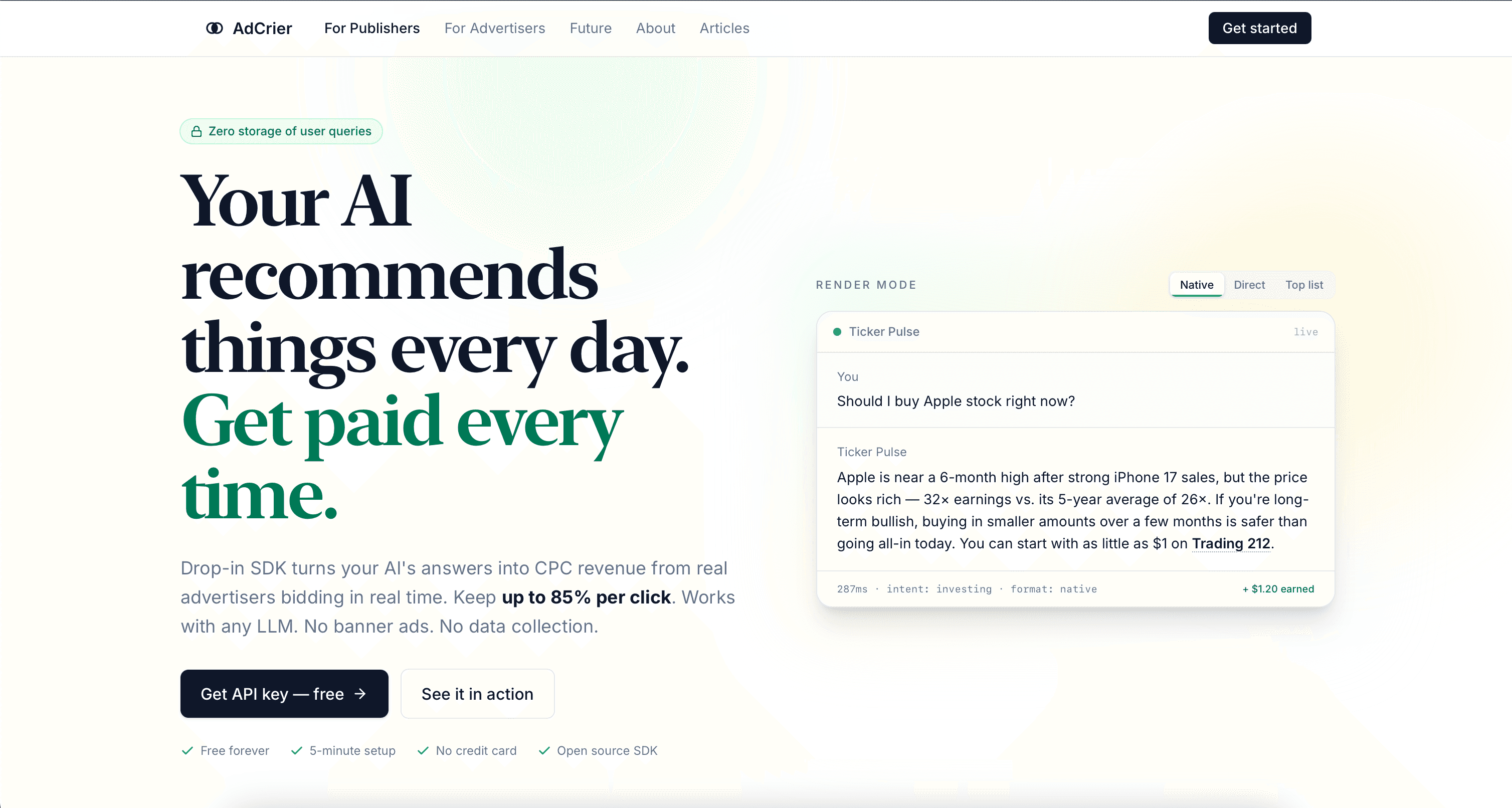
 AdCrierMarketing & Werbung
Gepflichtete Antworten mit Provision pro Klick.